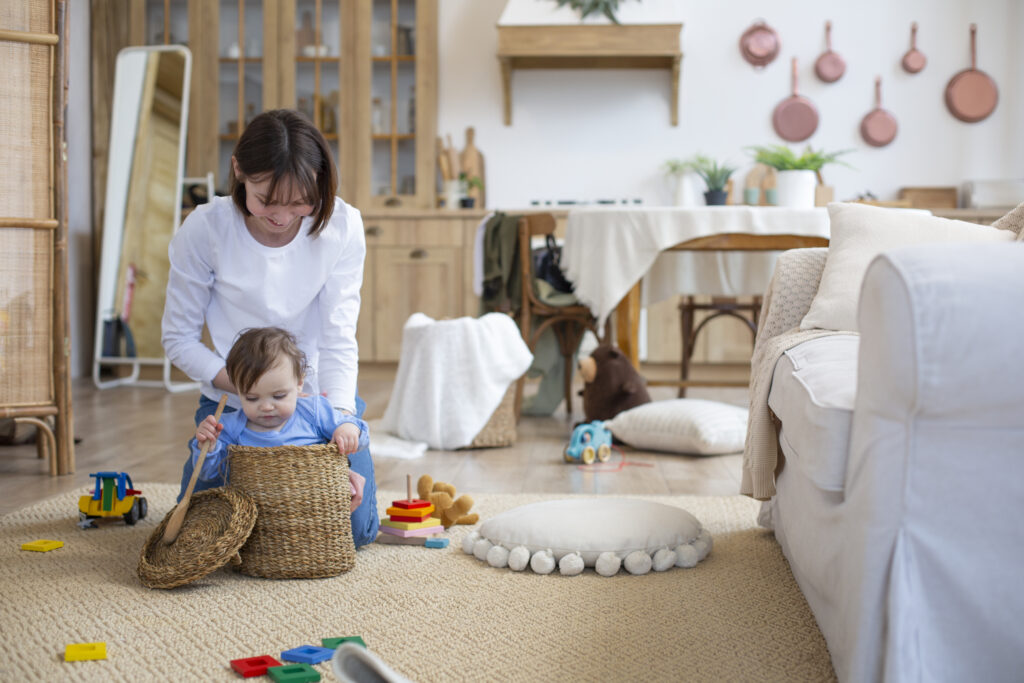
At eighteen months the gap between supervision and genuine developmental support is wide and easy to miss on a tour, because both look much the same for the twenty minutes a visitor is present. Children are safe, the room is clean, and nothing visibly wrong is happening. What distinguishes a strong programme is how adults interact with children through an ordinary hour, and that is observable if you know what to look for. Seven signs suggest a pre-nursery in Singapore is managing children rather than developing them.
1. Adults Supervise From the Edges Rather Than Engaging
Watch where the caregivers are. In a strong room they are on the floor, at the children’s level, talking, naming things, and responding to what children are doing.
Where adults stand at the perimeter watching, intervening only when something goes wrong, the room is being supervised rather than taught. At this age almost all learning happens through interaction with an adult, and children left to occupy themselves for long stretches are missing most of what the programme should provide.
2. Materials Are Stored Out of Reach
Shelves at adult height, toys in closed cupboards, and resources brought out only for planned activities indicate a room designed around adult control rather than child exploration.
Toddlers should be able to choose, carry, and return materials themselves. A playgroup in Singapore set up with low open shelving and accessible materials is signalling something about its approach that no curriculum description conveys as clearly, since the physical arrangement reflects whether children are expected to initiate or to wait.
3. The Room Is Noticeably Quiet
A room of eighteen-month-olds should sound busy: babbling, early words, adults narrating and responding.
Silence usually means children are passive, frequently in front of a screen or waiting between activities. Ask what the noise level you are hearing is typical of, and if the room is quiet because children are sitting, that is worth noting.
4. Language Is Limited to Instructions
Listen to what adults actually say. Strong practice at this age involves constant narration, naming objects, describing what a child is doing, and responding to attempts at communication.
Where adult speech consists mainly of directions, corrections, and transitions, children are receiving far less language exposure than they should during the period when it matters most.
5. There Is No Outdoor or Gross Motor Provision
Toddlers need to move. A programme without daily outdoor access or a dedicated indoor space for climbing, pushing, and running is missing a developmental area entirely.
Ask how much time children spend outdoors, what happens on wet days, and what gross motor equipment exists.
6. Displayed Work Is Uniform and Adult-Made
Twenty identical crafts on a wall at this age means adults made them. Genuine toddler work is messy, varied, and often unrecognisable.
Uniform displays indicate an emphasis on producing something for parents rather than on the process, which at eighteen months is where all the value sits.
7. Nobody Can Describe Your Child’s Day Beyond Meals and Sleep
Ask what daily feedback parents receive. If it covers only eating, napping, and nappies, nobody is observing development.
Strong programmes note what a child engaged with, what they attempted, and what they are working toward, because somebody is actually watching.
Observing for Longer Than the Tour Allows
Most of this requires watching a room for ten or fifteen minutes rather than passing through it, which means asking to stay and observe rather than following the presentation.
Centres comfortable with that generally have nothing to manage. Where a request to sit quietly in a room is declined without a clear reason, that response is worth weighing alongside everything else you saw, since the ordinary hour is the one your child will actually be living in.
Contact Raffles Kidz International to arrange a visit and observe a toddler session before you decide.